
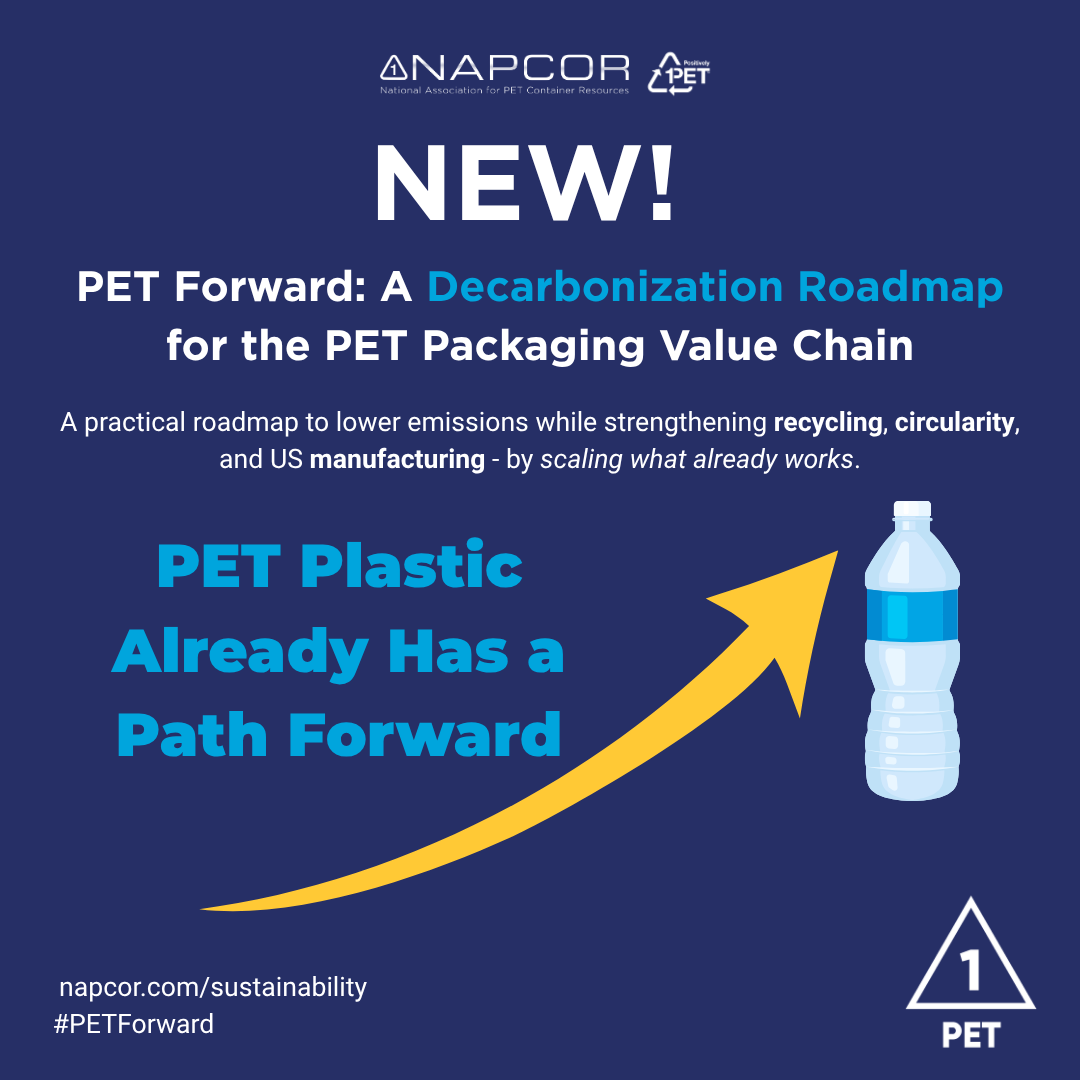
The answer: By strengthening collection, recycling, manufacturing, and innovation.
The US polyethylene terephthalate (PET) plastic bottle industry already has a pathway to reduce life cycle greenhouse gas emissions by expanding recycling, strengthening domestic manufacturing, and advancing circularity. PET is the plastic identified by the #1 inside the triangle ♳ and is commonly used for water, soda, and other beverage bottles.
NAPCOR’s PET Forward: A Decarbonization Roadmap for the PET Packaging Value Chain identifies a practical, modeled pathway through which the US PET industry could reduce the life cycle greenhouse gas emissions intensity of the PET beverage bottle systems studied by approximately 57% by 2050. In practical terms, that means significantly reducing the emissions associated with each bottle across its full life cycle, from the materials used to make it through its eventual disposal or recycling.
At the same time, total annual emissions associated with the systems studied could decline by approximately 42% by 2050, even as production grows. The roadmap shows that environmental progress and economic growth can work hand in hand and, in fact, need to work together.
Fast Facts from NAPCOR’s PET Forward: A Decarbonization Roadmap for the PET Packaging Value Chain
- Approximately 57% less emissions-intensive: By 2050, the emissions associated with PET beverage bottles across their full life cycle could be reduced by approximately 57%.
- Approximately 42% lower total annual emissions: Even as production grows, total annual greenhouse gas emissions associated with all beverage bottle systems could decline by approximately 42% by 2050.
- Why are the numbers different? The 57% figure describes how much the emissions intensity of PET beverage bottles could improve. The 42% figure describes the projected reduction in overall annual emissions across all the systems studied. They are different, complementary findings.
What Does a 42% Reduction in Annual Emissions Mean?
The projected 42% reduction in total annual greenhouse gas emissions is equivalent to:
- The emissions from approximately 323,000 gasoline-powered passenger vehicles driven for one year
- The carbon dioxide emissions from approximately 186,000 homes’ energy use for one year
- The carbon sequestered by approximately 4 million acres of US forests in one year
- The carbon sequestered by approximately 9 million tree seedlings grown for 10 years
These comparisons offer different ways to understand the scale of the same projected 42% reduction; they are not separate or additional emissions reductions. Equivalencies calculated using the US EPA Greenhouse Gas Equivalencies Calculator.
What would make these emission reductions possible?
The roadmap does not depend on a single technology, policy, or business practice. It identifies a portfolio of proven and emerging strategies that reinforce one another across the PET packaging value chain:
- Stronger collection and recycling systems for used PET bottles, which capture more PET already in circulation and make it available to US manufacturers.
- Greater use of recycled PET, which keeps valuable material in circulation and reduces demand for virgin (new) resources.
- Continued lightweighting, which uses less material while maintaining packaging performance and consumer convenience.
- Renewable energy and manufacturing efficiency, which reduce emissions from producing PET resin and bottles.
- Manufacturing innovation, including emerging technologies and lower-carbon inputs that can deliver additional reductions over time.
- Supportive public policy and infrastructure investment, which can accelerate collection, recycling, and private-sector adoption.
Importantly, many of the largest opportunities rely on technologies and practices that are commercially available today. Emerging solutions can deepen progress, but meaningful action does not have to wait for a future breakthrough.
Why should policymakers care about PET bottle decarbonization?
The roadmap’s projected emissions reductions do not depend on any single policy, technology, or recycling-rate target. Achieving them requires multiple strategies working together, including lightweighting, renewable energy, manufacturing efficiency, increased recycling and recycled content, stronger collection systems, and continued innovation.
Policymakers can help create the conditions that make several of these strategies possible. Policies that expand collection, strengthen domestic sorting and recycling infrastructure, and support durable end markets for recycled PET can increase the supply of high-quality recycled material available to US manufacturers. That can help reduce life cycle emissions while supporting jobs, private-sector investment, and more resilient domestic supply chains.
PET is already the most recycled plastic in the world and is supported by an established bottle-to-bottle recycling system operating at scale. The policy opportunity is to build on that foundation so more PET remains in circulation, less becomes waste, and the industry can move closer to the emissions reductions identified in PET Forward.
Which policy approaches can help move PET forward?
The roadmap points to a need for policies and public-private investments that improve the performance of the full system. Policymakers can help by:
- Expanding convenient, effective collection so more PET bottles enter the recycling stream.
- Investing in domestic sorting, processing, and recycling infrastructure.
- Supporting strong, durable end markets for recycled PET.
- Encouraging recycled content and other practices that keep material circulating.
- Allowing flexibility for manufacturers to use multiple emissions-reduction strategies, rather than relying on a single prescribed solution.
- Evaluating packaging policy using full life cycle data and measurable environmental outcomes.
The central lesson is straightforward: recycling policy is also climate policy, manufacturing policy, and economic policy.
How was the PET Forward decarbonization roadmap developed?
The National Association for PET Container Resources (NAPCOR) commissioned Eastern Research Group (ERG), an independent environmental consulting firm with expertise in life cycle assessments, to develop the roadmap. The peer-reviewed roadmap builds on NAPCOR’s peer-reviewed, ISO-compliant 2023 life cycle assessment of predominant US PET beverage bottle systems.
ERG modeled how recycling, recycled content, lightweighting, renewable energy, manufacturing efficiency, and other strategies could work together through 2050. The analysis draws on industry data, current technologies, and projected adoption scenarios. Additionally, an independent third-party industry expert peer-reviewed the final roadmap.
The path forward
PET Forward demonstrates that the US PET industry has a credible pathway to lower emissions without sacrificing the packaging performance consumers rely on or the manufacturing activity communities depend on. The opportunity now is to align industry action, public policy, and infrastructure investment around measurable progress.
By improving collection, strengthening domestic recycling, supporting end markets for recycled PET, and enabling continued innovation, policymakers can help turn an existing circular system into an even stronger climate and economic asset.
Explore PET Forward
Read NAPCOR’s PET Forward: A Decarbonization Roadmap for the PET Packaging Value Chain and related resources at https://napcor.com/sustainability/. Follow and share the campaign using the hashtag #PETForward.
Frequently asked questions about PET plastic decarbonization
What is PET Forward?
PET Forward: A Decarbonization Roadmap for the PET Packaging Value Chain is a science-based analysis of practical strategies to reduce life cycle greenhouse gas emissions across US PET beverage bottle systems through 2050.
What does “emissions intensity” mean?
Emissions intensity measures greenhouse gas emissions relative to a consistent unit of output. Here, it lets the roadmap show how much emissions associated with producing PET beverage bottles could decline while accounting for the volume of beverages packaged. This differs from total annual emissions, which measures the overall footprint of all systems studied in a given year.
Does the roadmap require breakthrough technologies?
No. Many of the largest reductions can be achieved using commercially available approaches already deployed across the PET value chain, including lightweighting, renewable energy, increased recycled content, and manufacturing efficiency. Emerging technologies may deliver additional reductions over time.
Why does collection matter to reduce emissions?
Collection of used PET bottles determines how much used PET plastic is available to recycle. Capturing more PET bottles increases the supply of recycled material for US manufacturers, strengthens domestic recycling infrastructure, and enables additional emissions reductions across the value chain.
Why improve PET instead of replacing it as a packaging material?
PET is fully recyclable and already has an established circular infrastructure. The roadmap shows that strengthening this existing system through better collection, more recycled content, lightweighting, cleaner energy, and continued innovation can deliver measurable environmental gains while supporting consumer needs and domestic manufacturing.
How does PET compare with aluminum or glass?
The roadmap examines opportunities to reduce emissions within PET beverage bottle systems; it is not a comparison among packaging materials. Previous life cycle assessments have found that PET performs favorably across several environmental indicators because it is lightweight, efficient to transport, and able to incorporate recycled content. Packaging decisions should be evaluated using full life cycle data rather than material type alone.
Explore the future of PET recycling.
Subscribe to the Positively PET blog for updates on PET recycling, sustainability, safety, and circular economy solutions. The subscription form is to your right on desktop and below on mobile.