
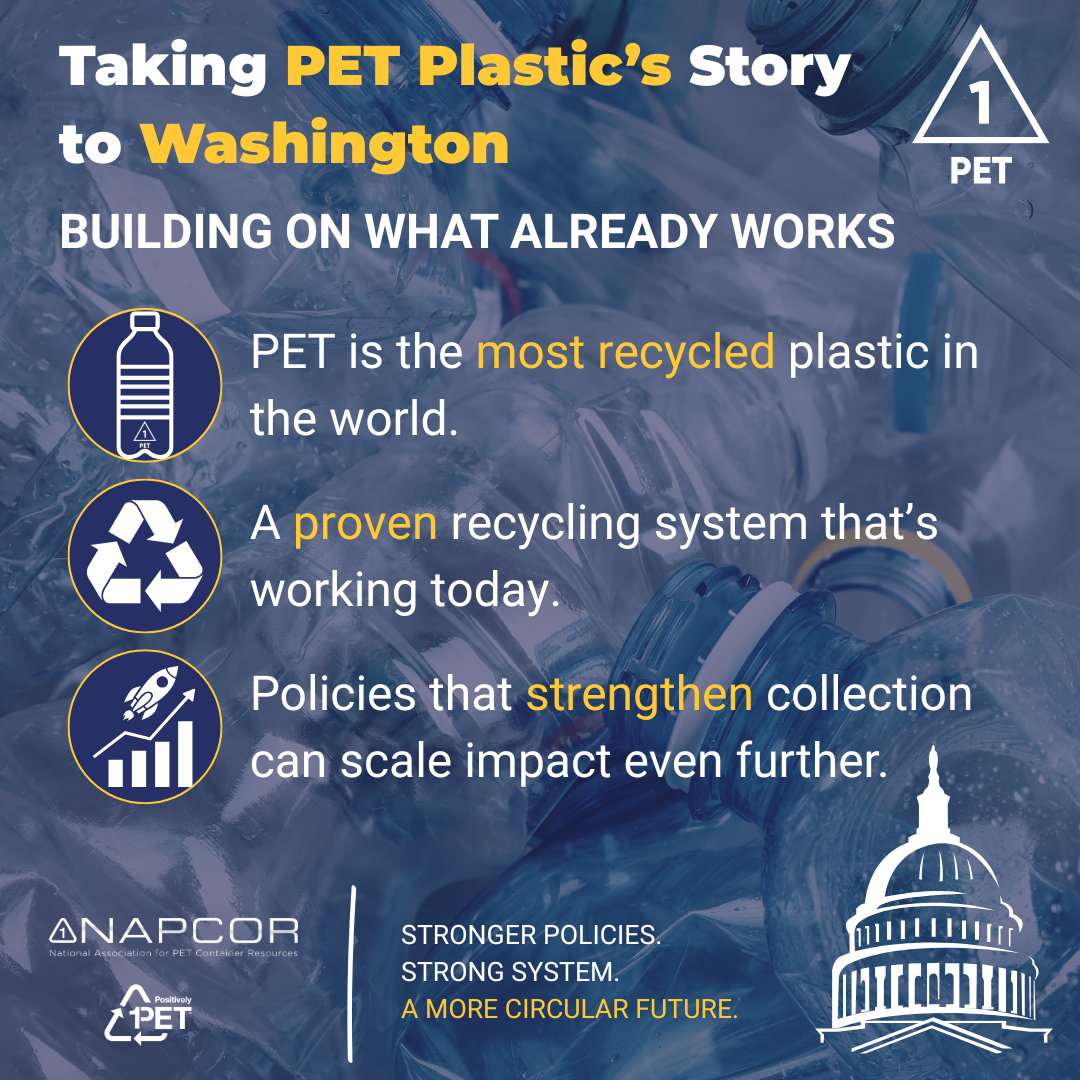
On May 13-14, NAPCOR and several of its members, leaders from across the PET plastic value chain, will be in Washington, DC, with a clear goal: to ensure policymakers understand what’s already working in US recycling and how to build on it.
As Congress considers how to reduce waste, strengthen recycling systems, and keep manufacturing jobs in the US, one important fact stands out: PET, the material used to package most water and beverage bottles, is already the most recycled plastic in the world, with a mechanical recycling system that is functioning today and ready to scale further. PET stands for polyethylene terephthalate and is recognized by the #1 inside the triangle.
PET is widely used because it is safe, lightweight, and durable. It is approved for food contact by leading global regulators and has been trusted for decades to protect products people rely on every day. Just as important, PET is designed to be circular. Unlike many other plastics, PET can be mechanically recycled over and over again, meaning used bottles can be collected, sorted, cleaned, and processed into material for new bottles and other products. That makes PET one of the clearest examples of a recycling system that is already working today.
In the United States, PET recycling reached a 30.2% collection rate in 2024, with 1.9 billion pounds of bottles collected and recycled each year. Across North America, that number climbs even higher. These real-world results demonstrate that PET recycling is already happening at scale. PET bottles are put back into the economy through new bottles, packaging, and clothing, creating a true circular loop.
The Opportunity Ahead
If PET is working, why come to Washington?
Put simply, because there is still significant untapped potential. Across the US, access to recycling and participation vary widely, and policy and infrastructure gaps are leaving valuable materials out of the system.
These gaps have real consequences. While demand for recycled PET remains strong, the challenge in the US is not a lack of potential supply, but a gap between what is recoverable and what is actually collected and processed. Strengthening collection systems and supporting domestic recycling capacity are key to closing that gap. There is an opportunity to build on PET’s value as a material, capturing more of it here at home to support American jobs, strengthen domestic recycling, and keep valuable resources circulating in the US economy.
Why Policy Matters
During this fly-in, industry leaders will meet with members of Congress, including the Congressional Recycling Caucus, to focus on strengthening collection policies to scale PET recycling in the US.
Policies that improve collection, such as Deposit Return Systems (DRS), Extended Producer Responsibility (EPR) programs, and infrastructure investments, can help capture more of the material already in circulation. When collection improves, recycling rates rise, domestic supply increases, and the entire system becomes more efficient.
Building on Progress
Recycling in the US is at an inflection point. The demand for circular solutions is growing, and the policy conversation is accelerating. PET offers a clear example of what progress looks like in practice.
PET plastic is a material with decades of safe use, a proven mechanical recycling system, and the ability to be remade again and again. The focus now is placed on capturing more of it, using it more efficiently, and scaling what already works.
That’s the message that NAPCOR and its members are bringing to Washington, and why it matters for the future of recycling in the United States.
Ready to learn more about PET’s potential? Explore our blog, where we dive into the most common questions about PET, or peruse the latest data and research about PET plastic.
Want to know the latest?
Subscribe to the Positively PET blog for updates on PET recycling, sustainability, safety, and circular economy solutions.