
The goal of the Positively PET campaign, developed and managed by NAPCOR (the National Association of PET Container Resources), is simple: to help consumers, policymakers, and other interested parties understand why PET (polyethylene terephthalate)—identified by the #1 inside the triangle—is the “1” plastic you can feel confident using and recycling.
After all, good decisions start with good information.
For our very first blog post, we are providing answers to the six most common questions we hear:
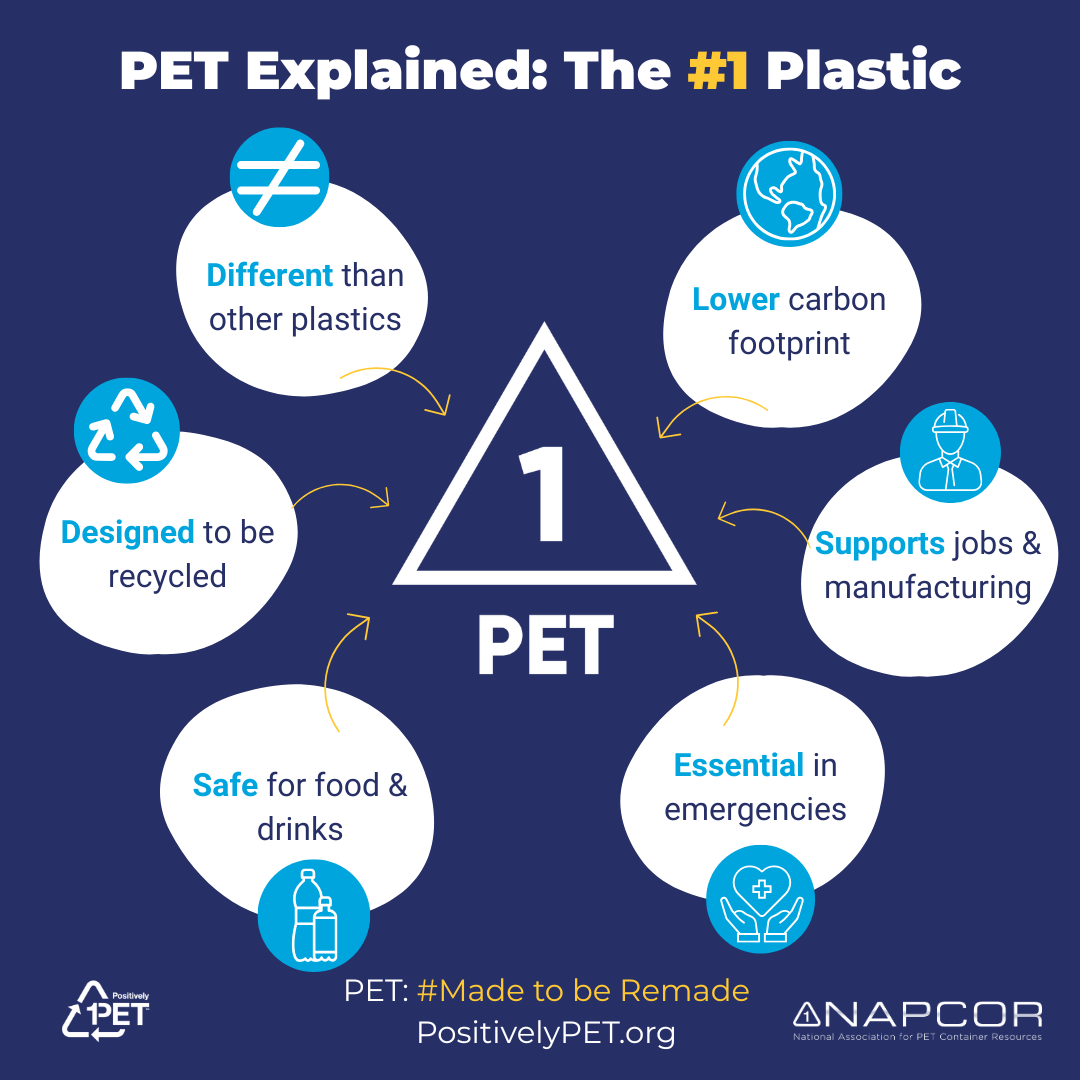
Quick facts about PET plastic
Before we dive deeper, here are a few key facts about PET:
- PET plastic is identified by the #1 recycling symbol (called a resin identification code).
- PET is widely recyclable and designed to be remade into new products
- PET is approved safe for food contact by major regulatory agencies worldwide
- PET packaging has a lower carbon footprint than heavier alternatives
- PET supports manufacturing, recycling, and jobs across the US and around the world
- PET is used to package critical supplies during emergencies
Now let’s look more closely at the questions people ask most often.
1. Are all plastics the same?
No. There are seven kinds of plastic, each with different properties and uses. Take a look at the container in your hand. If you see a “1” inside a triangle, that means it’s PET plastic.
PET differs from many other plastics because it is:
- widely recyclable and is the most recycled plastic in the world
- lightweight and durable
- shatter-resistant
- approved to package everything from food and beverages, to non-food items such as household cleaners and health and beauty products
Understanding the differences between the seven plastics helps people make informed choices about packaging and recycling systems.
2. Is PET plastic recyclable?
Yes. PET plastic is fully recyclable. In fact, it’s designed to be recycled. PET bottles and containers can be collected, recycled, and turned into new products, including new bottles made with up to 100% recycled content.
Recycled PET (often called rPET) is used to produce:
- new beverage bottles
- food packaging
- textiles and clothing (polyester is recycled PET)
- carpeting
- automotive components
The PET bottle you recycle today can return to store shelves as new packaging in as little as six weeks. That’s circularity in action.
3. Is PET plastic safe?
Yes. Both new (virgin) and recycled PET are approved safe for food contact by regulatory authorities worldwide, including:
PET plastic has been safely used to package beverages, food, personal care products, and medical supplies since the 1970s. Repeated studies, regulatory approvals, and scientific rigor have shown that PET is safe, time and time again.
BPA or PFAS are not used in the manufacturing or recycling of PET packaging. Extensive regulatory oversight ensures recycled PET used in food packaging meets strict safety standards.
More than four decades of scientific research and regulatory review continue to confirm PET’s safety for everyday use.
4. Is PET plastic bad for the environment?
No packaging is completely impact-free. However, PET plastic has a lower carbon footprint than alternatives like glass and aluminum.
Multiple studies, including research by McKinsey & Company, the University of Sheffield, and Franklin Associates (the latter commissioned by NAPCOR), have shown that PET plastic packaging requires less energy and generates fewer greenhouse gas emissions than heavier alternatives.
For example:
- A typical PET soda bottle has less than half the total greenhouse gas footprint of an aluminum can
- It has about one-fifth the footprint of a comparable glass bottle
Because PET is lightweight, it also reduces the fuel consumption during production and transportation. Combined with recycling, these characteristics help support a more circular and efficient packaging system.
5. Does PET plastic support the economy?
Yes. PET plastic plays an important role in manufacturing, packaging, and recycling systems across North America.
The plastics industry generates more than a million jobs in the US, many of them connected to PET production, packaging, and recycling.
PET packaging also delivers practical economic benefits:
- Lightweight bottles reduce transportation costs
- Durable containers reduce breakage and product loss
- Efficient manufacturing keeps products affordable for consumers
For many communities, PET manufacturing and recycling facilities provide stable jobs and local investment, often serving as a cornerstone of those communities.
6. Does PET plastic help during emergencies?
Yes, PET packaging often plays an essential role during emergencies.
Because PET bottles are lightweight, durable, shatterproof, and fully recyclable, they are widely used to package bottled water and essential supplies during disasters or when drinking water systems are disrupted.
During events such as earthquakes, floods, hurricanes, or infrastructure failures, PET-packaged bottled water can be quickly transported to affected communities.
PET plastic is also used in a variety of medical and protective applications, including personal protective equipment (PPE) used by medical workers and first responders.
PET plastic is #1 for a reason
There’s a lot of noise in today’s conversation about plastics and packaging. It can be difficult to know what information to trust.
Research from the University of Twente suggests consumers sometimes make environmental decisions based on misleading or incomplete information about packaging materials.
That’s why Positively PET focuses on data, science, and peer-reviewed research.
Our goal is simple: provide clear facts about PET plastic so consumers, policymakers, and other interested parties can make informed decisions about packaging and recycling.
Keep reading to explore the science, discover the facts, and learn why PET is one of the most widely used packaging materials and the most recycled plastic in the world.
Have a question we didn’t answer? Email lnichols@napcor.com.
Enjoyed this article?
Subscribe to the Positively PET blog for updates on PET recycling, sustainability, safety, and circular economy solutions.