
Public discussion around microplastics continues to draw greater attention to beverage packaging, consumer safety, and the role packaging plays in everyday life. As those conversations evolve, it is essential that public dialogue remains grounded in scientific rigor, context, and evidence-based conclusions.
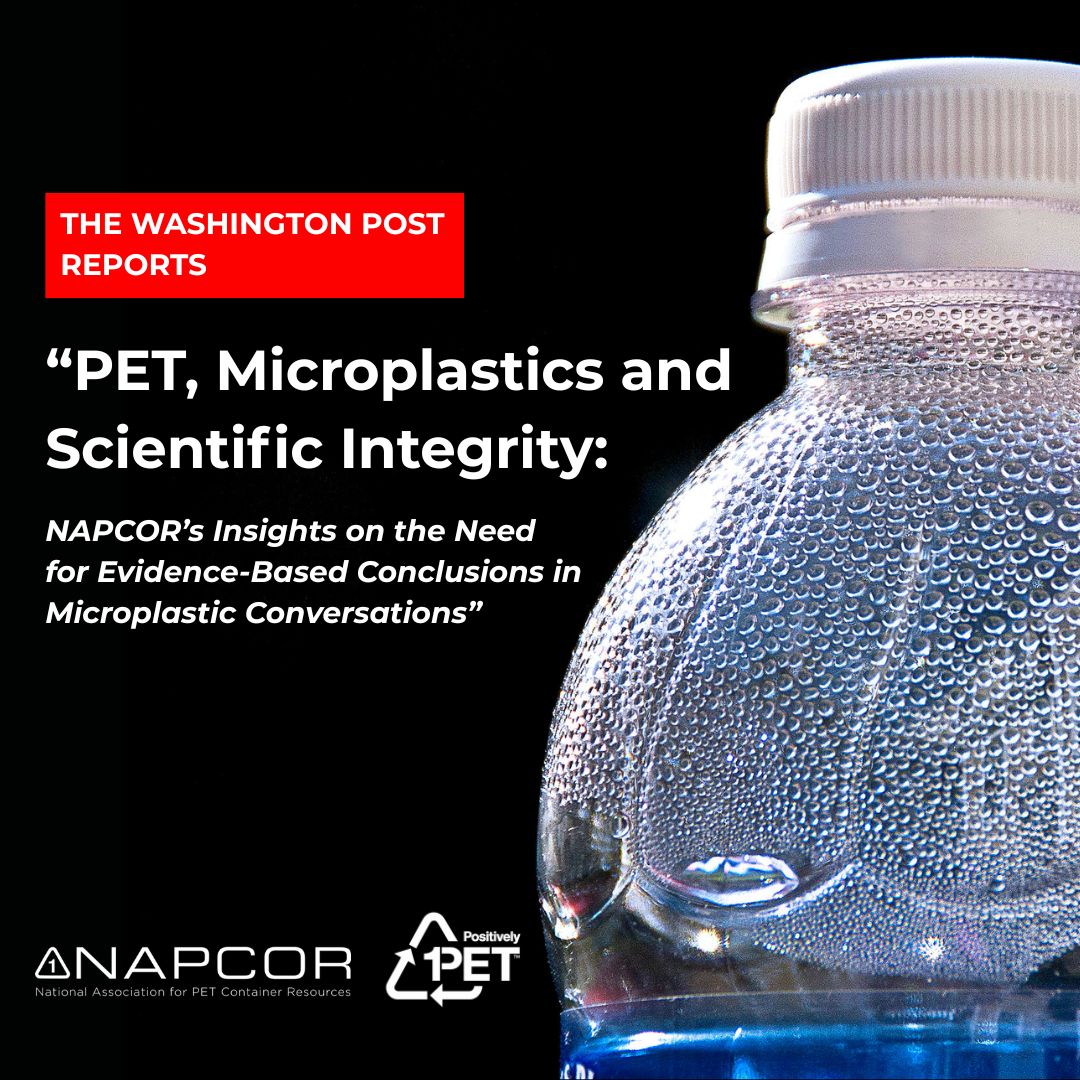
That’s why NAPCOR Executive Director Laura Stewart submitted a response to The Washington Post after the publication’s May 5 newsletter encouraged consumers to choose tap water over bottled water in connection with concerns about microplastics.
In the published letter to the editor, Stewart emphasized that PET (polyethylene terephthalate)—the material used to package most bottled water, identified by the #1 inside the triangle—is one of the most studied food-contact materials in the world. PET has been safely used for decades and continues to be approved by major global regulators, including the US Food and Drug Administration (FDA), the European Food Safety Authority (EFSA), and Health Canada.
The letter also highlighted an important reality often missing from public discussion: microplastics research is still developing, and globally standardized testing methods do not yet exist. Researchers continue to use different analytical techniques, contamination controls, particle-size thresholds, and methodologies, making comparisons between studies difficult and limiting the ability to draw broad conclusions with confidence.
Stewart also recently discussed these issues in Beverage Daily’s article, “Microplastics and plastic bottles: How worried should we be?”, where she emphasized the importance of distinguishing between emerging scientific questions and established evidence. She noted that conversations around PET packaging should remain grounded in material-specific science, standardized methodologies, and real-world exposure data rather than generalized assumptions about plastics overall.
As Stewart noted to both outlets, public concern deserves serious attention, but it also requires careful scientific interpretation. Discussions about packaging materials should distinguish between emerging hypotheses, preliminary findings, and established scientific consensus, and the unique characteristics of different materials.
NAPCOR supports continued research, improved testing methodologies, and constructive conversations about packaging sustainability and human health. We also believe those conversations should remain material-specific, science-led, and rooted in factual accuracy.
PET packaging plays an important role in modern life because it is lightweight, durable, shatter-resistant, and fully recyclable. PET is also the world’s most recycled plastic, helping support a growing circular economy for food and beverage packaging.
Read NAPCOR’s published letter in The Washington Post here. To learn more about PET plastic’s safety, click here.
Stay informed on all things PET.
Subscribe to the Positively PET blog for updates on PET recycling, sustainability, safety, and circular economy solutions.